| Riko: |
Hi, Emma. What are you doing with your tablet? |
| Emma: |
Hi, Riko. I’m looking [ ① ] some photos of snow crystals.
They are beautiful, right? |
| Riko: |
Oh, yes, they are. |
| Takeo: |
Hi, Emma and Riko. What are you doing? |
| Riko: |
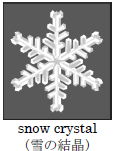
Hi, Takeo. Emma is showing me some photos of snow crystals on her tablet. |
| Takeo: |
Oh, they look beautiful. |
 |
| Emma: |
These photos were actually taken about 100 years ago. |
| Takeo: |
That’s a long time ago.
I didn’t know people could take such clear photos of snow crystals then. |
| Emma: |
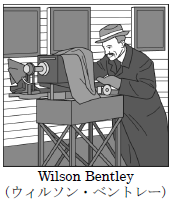
An American man, Wilson Bentley, was able to take those photos
after trying for a few years.
[ ② ] |
| Takeo: |
No. I don’t know about him. |
| Riko: |
I don’t know about him, either.
Can you tell us about him? |
| Emma: |
Sure. I read some books about the man before.
According to Ⓐthem, he got interested in snow crystals when he was 15 years old.
He lived in a village which had a lot of snow in winter.
On his 15th birthday, he got an old microscope from his family.
With that microscope, he saw snow crystals. |
 |
| Takeo: |
I think it was hard to see them with a microscope.
Snow disappears quickly in a warm room. |
| Emma: |
You’re right.
To see the snow crystals, he often used his microscope outside his house.
He didn’t mind staying outside in winter. |
| Riko: |
Wow. He was really interested in snow crystals. |
| Emma: |
By seeing many snow crystals with his microscope,
he found no snow crystals had the same shape.
He was excited to find that. |
| Takeo: |
Oh, I was also excited to find [ ③ ].
I’m glad that he and I felt excited about the same point about snow crystals. |
| Emma: |
That’s good, Takeo.
[ア]
Later in his life,
he expressed how he felt when he saw the various shapes of snow crystals.
[イ]
He said that every snow crystal was a masterpiece of design. |
| Riko: |
Oh, I like the phrase he used. |
| Emma: |
He [ ④ ] how beautiful shapes of snow crystals were. |
| Takeo: |
So, did he decide to take photos of snow crystals? |
| Emma: |
Yes, but, to take photos of very small things like snow crystals,
he had some difficult things to do.
[ウ]
First, he had to connect a camera to his microscope.
Also, in those days, he could only get a camera without high technology.
[エ]
He tried many ideas such as changing some parts of the camera. |
| Riko: |
Sounds hard. |
| Emma: |
After trying for a few years, he could finally take clear photos of snow crystals. |
| Riko: |
That means [ ⑤ ].
I can imagine how happy he was when he took the clear photo of a snow crystal
for the first time. |
| Emma: |
I agree. Through his life, he took more than 5,000 photos of snow crystals.
His photo book on snow crystals was first printed in 1931
and was sold in many stores. |
| Takeo: |
[ ⑥ ] |
| Emma: |
Yes. Actually, the photo book had an influence on a Japanese scientist.
The scientist was moved by the photo book
and he started his research on snow crystals.
He studied how the shapes of snow crystals were made.
His research is famous around the world. |
| Riko: |
Wow, it is interesting to know how one person’s works
affected the life of someone else.
I want to see more photos taken by Wilson Bentley.
Thank you for telling us about him, Emma. |
| Takeo: |
After hearing your story about him, I want to know more about snow crystals.
Thank you, Emma. |
| Emma: |
You’re welcome! |
| 〔注〕 microscope 顕微鏡 masterpiece 傑作 |
 英語(文章題) 令和7年(2025年)