英語(文章題) 令和8年(2026年)
  1. 残り時間が0になると、自動的に採点します。
  2. 時間内に終了する場合は、一番下の「採点する」のボタンを押してください。
残り時間: 分 秒
  2点 × 2問 + 3点 × 15問 = 49点
 No 令和8年(2026年)英語
問題原本はこちら → 大阪公立高校入試問題 英語(B)
1 高校生のケイコ(Keiko),イタリアからの留学生のソフィア(Sofia),
クラスメー卜のサトシ(Satoshi) の3人が昼休みに学校で交わした会話の一部です。
会話文を読んで,あとの問いに答えなさい。
Sofia: Keiko, I finished the water in my bottle.
I don’t have water to drink after P.E. class.
Keiko: [ ① ] worry, Sofia.
There is a drinking fountain in front of the gym.
You can fill your bottle with water there.
Sofia: That’s nice.
Keiko: I will take you there.
Sofia: Thank you, Keiko.
Satoshi: Hi, Keiko and Sofia. Where are you going?
Keiko: We are going to the gym to [ ② ].
Sofia wants to fill her bottle with water.
Satoshi: Oh, I will go with you.
I want to drink some water, too.
Keiko: Sure.
The three students walked to the gym, and stopped in front of it.
 The three students walked to the gym, and stopped in front of it.
Keiko: Here’s the drinking fountain.
Sofia: Thank you, Keiko.
Keiko: I often use this drinking fountain.
[ ③ ], Satoshi?
Satoshi: I use it very often, too.
I drink a lot of water during my club activity,
so I quickly finish the water I bring from home.
After finishing Ⓐit, I always use this drinking fountain.
Keiko: I see. Drinking fountains are convenient.
I also often use the one in the library near my house.
Satoshi: We can get water for drinking in many other places in the city.
Keiko: Sofia, are there drinking fountains in many places in your hometown?
Sofia: Yes! In my hometown, Rome, there are many drinking fountains along the streets.
People in Rome call them “nasoni .”
Satoshi: I have never heard that word before.
     
Sofia: It is an Italian word.
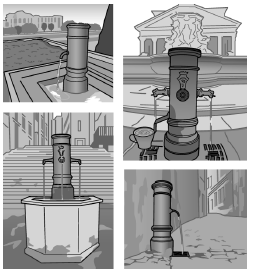
I’ll show you some pictures of nasoni on my tablet.
Keiko: Thank you. Oh, are these nasoni ?
They are very different from the drinking fountain in our school.
Satoshi: [  ④  ]
Sofia: Nasoni were first installed in the 1870’s.
They were installed for the health of people living in Rome.
Before that, people couldn’t get clean water easily,
and that caused a serious health problem.
After nasoni were installed along the streets, getting clean water became easier.
Keiko: You mean that [ ⑤ ], right?
Sofia: You are right! Nasoni supported their lives.
Keiko: Do local people still use nasoni ?
Sofia: Yes! When they are outside and feel thirsty, they get water from nasoni.
[ア]Nasoni are a part of their culture.[イ]
Satoshi: So, nasoni have helped local people for about 150 years.
Sofia: That’s right. People started to get clean water at home
and the number of nasoni decreased.
[ウ] So, when people want to drink water,
they can get water from nearby nasoni.[エ]
Keiko: Nasoni are convenient.
Sofia: Actually, on the Internet, there are helpful maps for finding the nearby nasoni .
Keiko: That’s interesting.
Sofia: Some of the maps were made to let people use nasoni more often to get water,
instead of buying water in a plastic bottle.
Now, some people in Rome often buy water in a plastic bottle.
But if they get water from nasoni more often,
that may be helpful for reducing plastic waste.
Satoshi: Nasoni are not only convenient but also eco-friendly.
I enjoyed learning about them.
Sofia: [  ⑥  ]
Keiko: Thank you for telling us about nasoni , Sofia.
Sofia: You are welcome.
 〔注〕
finish 飲み干す drinking fountain 給水器 Rome ローマ
nasoni ナゾーニ(ローマにある公共の給水器につけられた呼び名) (複数形)
install 設置する
問1 次のうち,本文中の [ ① ] に入れるのに最も適しているものはどれですか。
一つ選びなさい。

ア Don’t
イ Doesn’t
ウ Isn’t
エ Wasn’t

答え:
ア  イ  ウ  エ 

問2 本文の内容から考えて,次のうち,本文中の [  ②  ] に入れるのに
最も適しているものはどれですか。
次のア~エから選びなさい。

ア join a club activity
イ look for Sofia’s bottle
ウ see a P.E. teacher and ask her some questions
エ use the drinking fountain in front of it

答え:
ア  イ  ウ  エ 

問3 本文の内容から考えて、次のうち、
本文中の [  ③  ] に入れるのに最も適しているものはどれですか。
次のア~エから選びなさい。

ア Where do you use it
イ Where are they
ウ How about you
エ How far is it

答え:
ア  イ  ウ  エ 

問4 本文中の Ⓐit の表している内容に当たるものとして最も適している
ひとつづきの英語を,次のア~エから選びなさい。

ア the fountain I bring from home
イ the water I bring from home
ウ the server I bring from home
エ the hotwater I bring from home

答え:
ア  イ  ウ  エ 

問5 本文中の[ ④ ]が,「それらはとても古く見えます。」という内容になるように,
次のア~エから選びなさい。

ア 
イ 
ウ They look very old.
エ 

答え:
ア  イ  ウ  エ 

問6 本文の内容から考えて,次のうち,本文中の[ ⑤ ]に入れるのに最も適しているものは
どれですか。次のア~エから選びなさい。

ア nasoni were installed in homes in Rome
イ nasoni helped people in Rome stay healthy
ウ nasoni helped people clean the streets in Rome
エ nasoni were spread to many other countries in the world

答え:
ア  イ  ウ  エ 

問7 本文中には次の英文が入ります。
本文中の~ から,入る場所として最も適しているものを,
ア~エから選びなさい。

But there are still more than 2,500 nasoni in Rome now.

答え:
ア  イ  ウ  エ 

問8 本文中の[ ⑥ ]が,「私はナゾーニについて話せてうれしいです。」という内容になるように,
次の〔    〕内の語を並べかえたとき、正しいのはどれですか。
次のア~エから選びなさい。

I 〔 to talk glad am 〕 about nasoni .

ア am glad to talk
イ am glad talk to
ウ am to talk glad
エ am to glad talk

答え:
ア  イ  ウ  エ 

問9 次のうち,本文で述べられている内容と合うものはどれですか。
二つ選びなさい。(二つあって正解)

ア Sofia couldn’t drink water after P.E. class because she didn’t have her bottle.
イ According to Sofia, drinking fountains along the streets in Rome are called nasoni .
ウ Keiko said that nasoni in pictures Sofia showed were very similar to the drinking fountain at school.
エ According to Sofia, people in Rome don’t get water for drinking from nasoni anymore.
オ According to Sofia, using nasoni more often to get water may help people reduce plastic waste.

答え:
ア  イ  ウ  エ  オ 

2 次は,高校生のハルト(Haruto) が英語の授業で行った,
裂き織り(sakiori ) に関するスピーチの原稿です。
彼が書いた原稿を読んで,あとの問いに答えなさい。


 Last month, I visited Aomori Prefecture to see my grandparents.
There, we joined an event [ ① ] was held in a local hall.
In the event, I had a chance to weave cloth by using a traditional method called “sakiori .”
I also learned the history of sakiori from people who held the event.
Both weaving cloth with sakiori and the things Ⓐthey explained were interesting.
After that, I learned more about sakiori .
Today, I want to share [  ② ] .
 People started to use the method of sakiori in some areas of Japan in the middle of the Edo period.
It was used especially in the northern area for making people’s clothes.
At that time, it was hard to get cotton in the northern area.
The area was too cold for growing cotton plants.
[    ③    ] Instead of cotton, they often used hemp.
Clothes made of hemp were strong, but they were not very warm.
On the other hand, clothes made of cotton were soft and warm in winter,
so they were usually more comfortable.
 Though it was hard to get cotton,
sometimes people in the area could get some pieces of old cotton cloth.
The pieces were often damaged or they were often very small.
But people wanted to use them to make their clothes.
So, they created a method to make Ⓑthat possible.
They tore the old cotton cloth into strips and used those strips to weave new cloth.
To weave new cloth, they used not only those strips of cotton cloth but also strong threads,
such as threads made of hemp.
With a machine for weaving, they combined those strips and strong threads.
This way, people could make their clothes from old cotton cloth.
This method of weaving cloth is called sakiori.
The cloth which people wove with sakiori was strong and helped people stay warm in cold winters.
 As the society changed, the number of people
who wove cloth with sakiori got smaller in the 20th century.
However, now, in the 21st century, some people pay attention to sakiori for some reasons.
Some people think sakiori is a good method to recycle old things.
By using it, they don’t have to throw away their old clothes.
Also, some people think it is a good method to keep a part of their favorite clothes
which became too old.
They want to keep such clothes because the clothes remind them of a lot of memories.
By using such favorite clothes, they make something else, such as a small bag.
This way, they can [   ④   ].
 In the event I joined, to weave cloth with the method of sakiori ,
I used some old clothes my grandparents bought for me.
The cloth I wove was very different from my old clothes.
It was unique in the world.
Through learning about sakiori ,
I could know about people’s wisdom to handle difficult situations they had.
[   ⑤   ] I think each of them has their own unique history.
There are many things we can learn from them.
 〔注〕
Aomori Prefecture 青森県 weave 織る(過去形はwove) cotton 木綿
cotton plant 綿花 hemp 麻
tore tear(裂く,引き裂く) の過去形 strip (布の) 細長い一片
thread 糸 combine 組み合わせる
問1 次のうち,本文中の [ ① ] に入れるのに最も適しているものはどれですか。
次のア~エから選びなさい。

ア what
イ when
ウ which
エ where

答え:
ア  イ  ウ  エ 

問2 本文の内容から考えて,
本文中の Ⓐthey の表している内容に当たるものとして最も適している語を
次のア~エから選びなさい。

ア people what held the event
イ people where held the event
ウ people when held the event
エ people who held the event

答え:
ア  イ  ウ  エ 

問3 本文中の
‘Today, I want to share[  ② ] .’ が,
「今日は,私が何を学んだかを共有したいと思います。」という内容になるように,
次のア~エから選びなさい。

ア what I learned
イ that I learned
ウ which I learned
エ I learned

答え:
ア  イ  ウ  エ 

問4 本文中の [  ③  ] に,
次の (ⅰ) ~ (ⅲ) の英文を適切な順序に並べかえ,
前後と意味がつながる内容となるようにして入れたい。
あとのア~エのうち,英文の順序として最も適しているものはどれですか。
一つ選びなさい。

(ⅰ) But the cotton brought from those far areas was very expensive.
(ⅱ) Many people in the area couldn’t easily get it and they used something else to make their clothes.
(ⅲ) So, cotton was brought to the area from warm areas which were far away.

ア (ⅰ) → (ⅱ) → (ⅲ)
イ (ⅰ) → (ⅲ) → (ⅱ)
ウ (ⅲ) → (ⅰ) → (ⅱ)
エ (ⅲ) → (ⅱ) → (ⅰ)

答え:
ア  イ  ウ  エ 

問5 次のうち,本文中のⒷthat の表している内容として最も適しているものはどれですか。
一つ選びなさい。

ア getting new cotton cloth
イ finding cloth they threw away
ウ weaving cloth without using cotton cloth
エ using old cotton cloth to make their clothes

答え:
ア  イ  ウ  エ 

問6 本文の内容から考えて,
次のうち,本文中の [ ④ ] に入れるのに最も適しているものはどれですか。
次のア~エから選びなさい。

ア carry many things they need for weaving cloth with sakiori
イ keep a part of their favorite clothes with memories in a different product
ウ recycle a lot of small bags in an effective way
エ remember what products they can make with sakiori

答え:
ア  イ  ウ  エ 

問7 文中の[ ⑤ ] が,
「それについて学ぶことは,私に他の伝統的な方式にも興味をもたせました。」
という内容になるように,次の〔   〕内の語を並べかえたとき,
正しい語順を,次のア~エから選びなさい。

Learning about it 〔 in interested made me 〕 other traditional methods, too.

ア made interested me in
イ made in me interested
ウ made me interested in
エ made me in interested

答え:
ア  イ  ウ  エ 

問8 次のうち,本文で述べられている内容と合うものはどれですか。
一つ選びなさい。

ア In the middle of the Edo period, people in the northern area of Japan created a method to grow cotton plants in the area.
イ Clothes made of hemp were softer and warmer than clothes made of cotton.
ウ In the 20th century, the number of people who wove cloth with sakiori increased.
エ Some people think, with sakiori , they can recycle old clothes.

答え:
ア  イ  ウ  エ